

You know that feeling when someone tells you to “just relax” — and your entire body wants to scream back, “I WOULD IF I COULD”?
Your shoulders are up around your ears.
Your mind’s racing.
Your heart’s going like the clappers (not fun at all).
And someone says it.
Just. Relax.
Right. Helpful.
Table of Contents
Why nervous system regulation breathwork matters more than “trying to relax”
Here’s the thing…
You’re not failing at relaxing.
Your nervous system is doing exactly what it’s been trained to do.
If you’ve spent years managing everyone else, holding everything together, and pushing through exhaustion (despite theoretically knowing better)… your body learns that being “on” is normal.
So when someone tells you to relax, your system goes:
“Nope. That doesn’t feel safe.”
That’s why nervous system regulation breathwork is so powerful — because it works with your body, not against it.
Why “just relax” doesn’t work (and never has)
Let’s be honest…
If it were that simple, you’d have sorted this years ago.
This isn’t a mindset issue.
It’s not about willpower.
Because stress isn’t just in your thoughts — it’s in your body.
- Your breath becomes shallow
- Your chest tightens
- Your jaw clenches
You shift into fight, flight, or freeze.
And once you’re there, you can’t think your way out.
This is exactly where nervous system regulation breathwork comes in — giving your body a physical way back to calm.
What actually works for nervous system regulation
Right… let’s make this practical.
(Not the sit-on-a-mountain-and-find-yourself kind — the works-when-Tuesday-feels-like-a-month kind.)
Your breath is the fastest way to communicate with your nervous system.
No equipment.
No perfect conditions.
No extra time needed.
Just something you already do — slightly differently.
Your body needs signals, not instructions
When someone says “relax”, they’re talking to your brain.
But your body doesn’t respond to instructions.
It responds to signals.
And breathing is one of the clearest signals you’ve got:
- Fast breathing = danger
- Slow breathing = safety
So instead of telling your body to calm down…
You show it.
That’s the foundation of nervous system regulation breathwork.
A simple nervous system regulation breathwork technique
Let’s keep this really doable.
The 4–4 breathing rhythm
- Breathe in through your nose for 4
- Breathe out through your nose for 4
- Keep it gentle (no forcing)
- Continue for 2–3 minutes
That’s it.
No perfection required.
No special setup.
(And yes, it might feel almost too simple — that’s usually when people stop. Don’t.)
What’s happening in your body when you do this
When you slow your breathing like this, you activate your parasympathetic nervous system.
That’s the part responsible for calming everything down.
According to the NHS, breathing exercises can help reduce stress and anxiety by calming the body’s stress response:
https://www.nhs.uk/mental-health/self-help/guides-tools-and-activities/breathing-exercises-for-stress/
So no — this isn’t fluffy.
It’s biology.
And it’s exactly why nervous system regulation breathwork works when “just relax” doesn’t.
Why this works in real life (not ideal life)
Because you’re not asking your body to suddenly switch off.
You’re giving it a bridge.
Something it can actually follow.
And this is how things shift:
Not in big dramatic breakthroughs…
But in small moments where your body realises:
“Oh… we’re safe now.”
The bit nobody tells you (but I will)
When you start using nervous system regulation breathwork, it can feel uncomfortable.
You might feel:
- restless
- impatient
- slightly on edge
That doesn’t mean it’s not working.
It means your system isn’t used to slowing down yet.
And that’s okay.
Stick with it.
Where this fits into your actual life
This is why breathwork works so well.
You can use it:
- before you walk into the house
- in the bathroom at work (we’ve all done it)
- lying awake at 3am
- mid-conversation when things feel too much
This isn’t about creating a perfect routine.
It’s about having something that works in real life.
If you need more support with nervous system regulation
And look… sometimes you need more than a quick technique.
Sometimes your system has been running on high alert for years.
That’s where deeper breathwork comes in.
If this is resonating, you can explore:
- Sacred Pause (1:1 session):
https://www.wessexwisewoman.co.uk/sacred-pause-2/ - Or start gently here:
https://www.wessexwisewoman.co.uk/awaken-your-inner-magic/
No pressure. Just options.
A different way to think about “relaxing”
Maybe the question isn’t:
“Why can’t I relax?”
Maybe it’s:
“What does my body need to feel safe right now?”
Because that’s what you’re really looking for.
Not forced calm.
But a moment where you can soften… even slightly.
One small step to try today
Before you scroll on…
Try one minute.
Inhale for 4.
Exhale for 4.
No pressure.
No perfection.
Just notice what shifts.
Final thoughts
Look… you were never meant to override your body this much.
No wonder “just relax” feels impossible.
But your body hasn’t forgotten how to calm down.
It just needs a different kind of conversation.
And nervous system regulation breathwork?
That’s where that conversation begins.
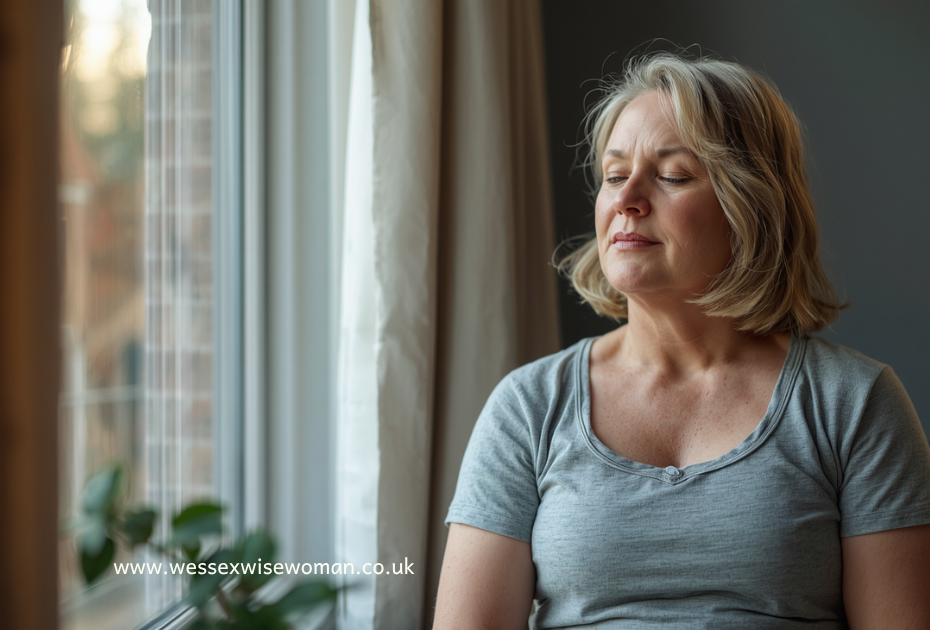
Your breath has been waiting patiently for you to remember it matters.
Maybe it’s time to listen.

Kim Brockway is a breathwork coach and pagan wisdom keeper based in Salisbury, Wiltshire.
She works with midlife women who are done with running on empty — online and in-person across Wiltshire and beyond.
Pingback: Exploring Conscious Connected Breathwork: Benefits, Risks, and What to Expect - Wessex Wise Woman
Comments are closed.