

Right, let’s talk about air hunger — because it’s one of those things that can make you feel like you’re losing your mind when it happens.
You’re breathing. You know you’re breathing. And yet your body is screaming at you that you’re not getting enough air. It’s one of the most alarming sensations a human can experience, and it’s also one of the most misunderstood.
So let’s sort that out.
What Actually Is Air Hunger?
You know that horrible feeling when you can’t seem to get a proper breath in? Like you’re gasping, but nothing’s working? That’s air hunger. From the outside, your breathing looks totally normal — your chest is rising and falling, you’re clearly alive — but inside you’re desperate for more air.
And here’s the kicker: the more you try to gulp down air, the worse it gets. Cruel, isn’t it?
Air hunger is technically called dyspnoea in the medical world, but that doesn’t make it feel any less terrifying when you’re in the middle of it. It can arrive out of nowhere — in the middle of a work call, lying in bed trying to sleep, or sitting quietly doing nothing particularly stressful at all. That unpredictability is part of what makes it so unsettling.
Why Does Air Hunger Happen?
Most of the time, air hunger happens because we’re breathing too fast and too shallow — usually when we’re stressed or anxious, or when that’s simply become our default pattern over time.
Sounds backwards, but when we over-breathe or hyperventilate, we’re actually making things worse by messing with our CO₂ levels. We exhale too much carbon dioxide too quickly, and the body — which needs a certain amount of CO₂ to function properly — panics.
Sometimes it’s medical: asthma, heart conditions, anaemia, and a few other things can all cause air hunger and are worth ruling out with your GP if it’s a regular occurrence. But honestly? A significant proportion of cases are rooted in dysfunctional breathing patterns — habits we’ve developed, often over years, that have taught our nervous system the wrong normal.
The good news is that habits can be changed. Patterns can be retrained. And breath is one of the most responsive systems in the body when you give it the right conditions to work with.
Here’s the Thing About CO₂
We’ve been told CO₂ is just waste gas — breathe it out, get rid of it, job done. But actually, we need a certain amount of carbon dioxide in the body. It’s not the enemy we thought it was.
This is where it gets genuinely fascinating (bear with me, because the science here is brilliant).
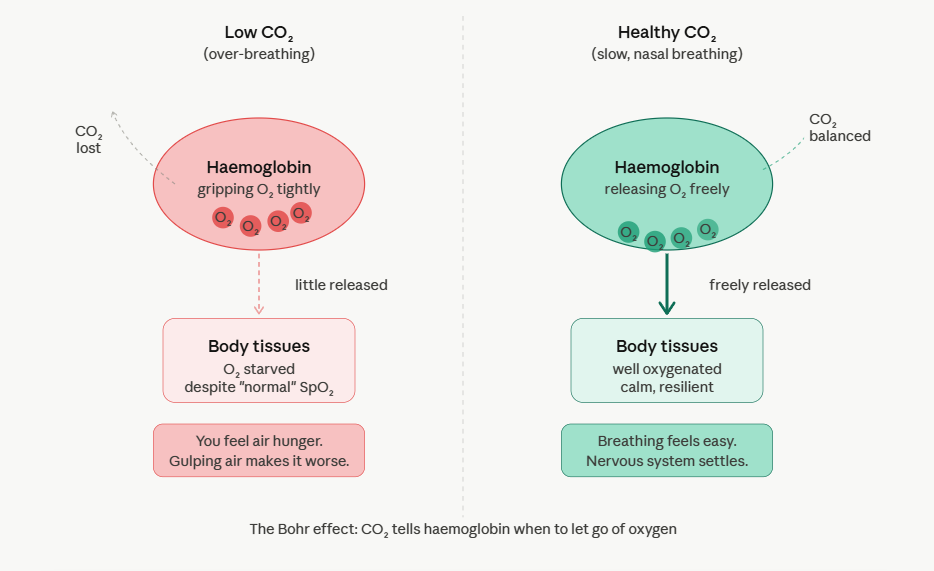
Carbon dioxide plays a critical role in something called the Bohr effect — a physiological mechanism that determines how well your red blood cells actually release oxygen to your tissues. Here’s the counterintuitive bit: without sufficient CO₂, your haemoglobin holds too tightly to oxygen, meaning your cells receive less of it even when your blood oxygen saturation looks perfectly normal on a monitor. You can be, technically, “breathing fine” and still have your tissues gasping.
So when you exhale too much CO₂ through fast, shallow breathing, you’re not just losing a waste product — you’re actively reducing your body’s ability to use the oxygen you do have. Which is why air hunger so often gets worse, not better, when you try to breathe more. You’re compounding the very imbalance that caused it.
What Happens When You Build CO₂ Tolerance
When your body becomes more comfortable with CO₂ — when your tolerance for it increases — some genuinely significant things start to happen:
- You don’t get that panicky “must breathe NOW” feeling as quickly or as intensely
- Your blood delivers oxygen more effectively to the tissues that need it (thank the Bohr effect for that)
- Your nervous system settles — you feel calmer and more resilient under stress
- Your breathing rate naturally slows, which further stabilises CO₂ levels
- If you’ve got asthma or breathing issues, symptoms often ease as the airways stop reacting to the CO₂ imbalance
This isn’t about pushing through discomfort for the sake of it. It’s about giving your nervous system new information — teaching it that the levels of CO₂ it’s been interpreting as dangerous are actually perfectly fine, and that it doesn’t need to fire the alarm.
So What Can You Do About Air Hunger?
The beautiful thing is: you can train your body to become more CO₂ tolerant. It’s not about holding your breath for ages or doing anything extreme or dramatic. It’s about retraining your system — slowly, consistently, gently — with low, slow breathing instead of that frantic, shallow gulping.
Start simply. Breathe in through your nose for a count of four. Breathe out through your nose for a count of six. The longer exhale is key — it’s what activates the parasympathetic nervous system, the bit responsible for rest and calm. Do this for two minutes and notice what shifts.
If air hunger is a regular visitor in your life, a few things are worth trying consistently:
Nasal breathing over mouth breathing. Your nose filters, warms, and humidifies air, and crucially, it produces nitric oxide which helps dilate the airways. Mouth breathing bypasses all of that and tends to make us breathe faster and more shallowly.
Slow your exhale. If your inhale and exhale are roughly the same length, you’re likely breathing more than you need to. Experiment with making your exhale slightly longer than your inhale.
Breathe less, not more. This feels counterintuitive when you’re desperate for air, but taking smaller, lighter breaths and allowing a brief natural pause after the exhale can do more for air hunger than any amount of deep gulping.
This is where breathwork comes in — not the woo-woo mystical stuff (though I love that too), but practical, science-backed techniques that help your nervous system remember how to breathe properly again.

A Note on Getting Support
If air hunger is something you’re experiencing regularly, please do rule out any medical causes with your GP first. This isn’t about frightening you — it’s just good sense, and most causes are straightforward to identify.
Once you’ve done that, if the pattern persists, it may well be rooted in the kind of dysfunctional breathing habits that breathwork can genuinely address. The BreathHealing Release™ session I offer is specifically designed for this kind of deeper work — resetting breathing patterns at a nervous system level rather than just practising techniques on the surface.
You can also find some free starting-point resources over on the free breathwork resources page if you’d like to explore first.
If you’re dealing with air hunger regularly, you’re not broken, and you’re not doing anything wrong. Your body is trying to protect you in the only way it knows how — it’s just working from outdated information.
We just need to teach it a better way.
Kim x
Further reading: The Bohr effect and its relationship to oxygen delivery is well documented in respiratory physiology literature. A good starting point is this overview from the National Library of Medicine on haemoglobin and oxygen transport. For more on CO₂ tolerance and dysfunctional breathing patterns, the work of Professor Konstantin Buteyko offers a useful (if occasionally contested) framework that has nonetheless generated significant clinical interest.